Published
- 26 min read
What to Do on Taveuni Island, Fiji
There is a telling moment that many visitors experience when they first fly into Taveuni. The small Fiji Link turboprop drops below the clouds somewhere north of Vanua Levu, and what appears below is not the postcard Fiji of white sand and turquoise lagoons — it is something else entirely. A dense, almost aggressive wall of green covers every ridge and valley, broken only by the occasional cascade of water catching the light and the dark soil of a smallholding hacked out of the forest’s edge. The sea around the island is deep blue-black, the kind of colour that speaks to depth rather than the shallow reef-lit shallows most people picture when they imagine Fiji. It is both beautiful and startling, and it announces clearly that Taveuni operates on different terms to the islands most visitors know.
Taveuni is Fiji’s third largest island and, among those who have actually been there, arguably its most beautiful. The “Garden Island” nickname is not marketing hyperbole — it is simple botanical fact. The island sits in one of the highest rainfall zones in Fiji, and that rainfall sustains a tropical rainforest of extraordinary density and variety. Waterfalls appear without warning on hillsides across the island. The roads are edged with flowers. The soil is volcanic, deep red, and visibly fertile. What the island lacks in long white beaches it compensates for in lushness, and visitors who arrive expecting a conventional Fiji beach resort experience and instead find a functioning tropical ecosystem tend, almost without exception, to be grateful for the difference.
The activities on Taveuni divide naturally into four categories, each extraordinary in its own right. Rainbow Reef — the channel between Taveuni and Vanua Levu — is home to some of the finest soft-coral diving in the world, and the Great White Wall is a site that ranks among Fiji’s most famous and justifiably so. The Bouma National Heritage Park covers a substantial portion of the island’s interior and east coast, encompassing the Tavoro Waterfalls and the Lavena Coastal Walk. Birdwatching draws specialists from across the Pacific, with Taveuni hosting an extraordinary concentration of endemic and rare species including the spectacularly orange Orange Dove and the elusive Silktail. And beyond all of that, Taveuni offers something increasingly rare in Fiji’s more developed reaches: the sense of an island that has not yet been entirely reorganised around the preferences of tourists.
Getting There
Taveuni is served by Matei Airport in the island’s north, operated by Fiji Link — the domestic arm of Fiji Airways. Scheduled flights depart Nadi approximately twice daily and take around 45 minutes; the route via Suva is roughly 30 minutes. Fares vary seasonally and by how far in advance you book, but expect to pay approximately FJD $200–$350 each way. Matei Airport is small in the most literal sense — there is a single runway, a modest terminal building, and almost no services on site. Luggage allowances on Fiji Link’s domestic routes are strictly enforced and typically set at 15kg for checked baggage, sometimes less depending on aircraft type. Confirm your allowance when booking and do not assume that oversized dive bags or camera equipment will be waved through — excess baggage fees at small island airports are a well-known and avoidable expense.
A second option is the Patterson Brothers ferry, which operates a service between Savusavu (on Vanua Levu) and Taveuni’s Waiyevo wharf. The crossing takes approximately one hour and is the most practical route for travellers who are combining Taveuni with a Savusavu visit. Patterson Brothers also operates an overnight service from Natovi Landing near Suva — a journey of several hours that arrives in the early morning. The overnight ferry is an option for budget-conscious travellers but the experience is basic, and the crossing can be rough in poor weather. Flying from Nadi is the more comfortable and time-efficient choice for most visitors.
Most accommodation on Taveuni is concentrated in the north of the island near Matei, which puts guests close to the airport and within convenient reach of the dive operators who work the Rainbow Reef channel. The island’s administrative centre, Waiyevo, sits on the west coast and offers the island’s most significant cluster of shops, a hospital, and a handful of guesthouses. Taxis meet arriving flights at Matei Airport — rates are negotiable but expect to pay FJD $10–$20 to most accommodation in the Matei area. For properties further south along the coast, confirm transfer arrangements before you arrive.
Diving Rainbow Reef
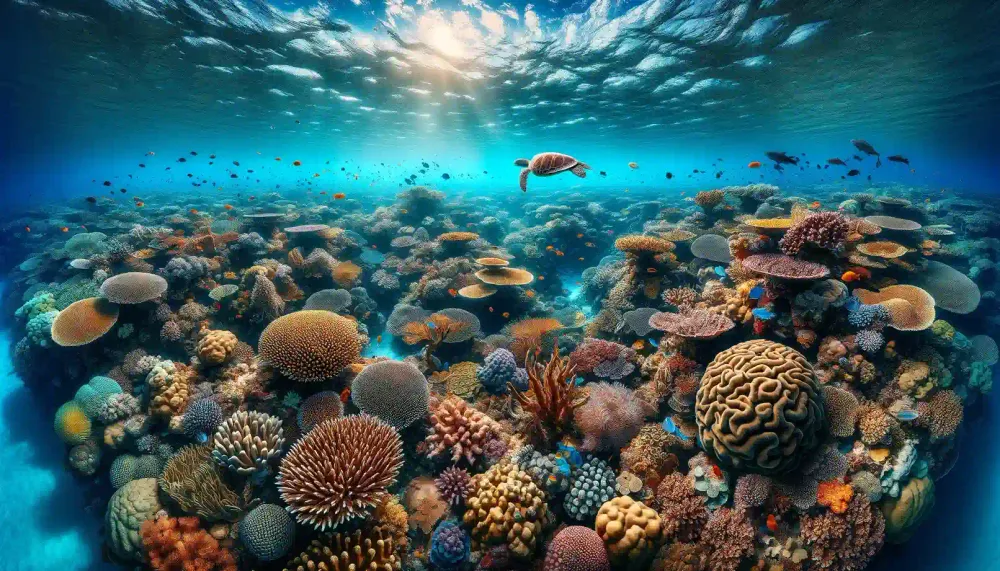
Rainbow Reef is the primary reason most visitors come to Taveuni, and it is one of those relatively rare cases where a dive site’s reputation and its reality are in close agreement. The reef occupies the Somosomo Strait — the 20-kilometre channel that separates Taveuni from the larger island of Vanua Levu to the west — and the tidal flows through that strait create the nutrient-rich, current-driven conditions in which soft corals grow to extraordinary size and density. The colours — purples, oranges, yellows, and the brilliant white that gives the most famous site its name — are among the most vivid of any reef system in the Pacific.
The Great White Wall is Rainbow Reef’s signature dive and one of the most recognisable sites in all of Fiji. The dive begins on the top of the reef in relatively shallow water, where hard corals and reef fish provide a conventional reef experience. At a marked point, the reef edge drops away entirely into a near-vertical wall that descends beyond recreational diving limits. The wall, from roughly seven metres down to around 30 metres, is blanketed in white soft corals — Dendronephthya species that, under the right conditions, extend fully and create a mass of white and pale pink growth that does genuinely look, at depth, as though the wall has been covered in snow. The effect is extraordinary and unlike anything else available in Fiji’s more visited reefs.
The critical practical detail about the Great White Wall is its tidal dependency. The soft corals extend and display best during a rising tide, when current pushes nutrient-rich water up the strait and through the reef. At slack water or on a falling tide, the same corals contract and the wall loses much of its spectacle. Experienced dive operators on Taveuni schedule Great White Wall dives to coincide with the correct tidal window — typically two to three hours before high water — and this means departure times vary day to day rather than operating on a fixed morning/afternoon schedule. Listen to your operator’s timing recommendations; diving this site on the wrong tidal phase is a genuinely significant loss of experience.
Other notable sites on Rainbow Reef include The Cabbage Patch, a shallower dive where enormous plate corals up to several metres across create an otherworldly landscape in around 10–18 metres of water — excellent for photographers and less experienced divers who find the current at the Great White Wall demanding. Jerry’s Jelly is a drift dive named for the jellyfish aggregations that appear seasonally in the strait, with significant soft coral coverage and the opportunity to cover substantial ground with the current rather than against it. The Blue Ribbon Eel Reef is a more sheltered site suited to macro photography, named for the electric-blue ribbon eels — Rhinomuraena quaesita — that inhabit the coral rubble zones here in numbers unusual for a single site.
The Somosomo Strait’s current-driven conditions mean that Rainbow Reef diving is not suited to complete beginners. An Open Water certification is the minimum entry point; Advanced Open Water certification is recommended for the Great White Wall’s deeper sections and for managing drift diving conditions. Aqua-Trek Taveuni is the island’s best-established dedicated dive operator and runs a well-organised programme from the Matei area, with guides who know the sites and the tidal patterns intimately. Taveuni Ocean Sports is a second operator offering similar services. Most of the island’s mid-range resorts either operate their own dive shops or have standing arrangements with one of these operators. Expect to pay approximately FJD $280–$330 for a two-tank dive including equipment.
The best time for Rainbow Reef diving is the dry season, May through October, when visibility regularly reaches 25–30 metres and sea conditions in the strait are more settled. Visibility during the wet season (November–April) can be reduced by river run-off and rain, but diving continues year-round and the reefs remain healthy and active throughout.
Bouma National Heritage Park
The Bouma National Heritage Park covers approximately 150 square kilometres of Taveuni’s interior and eastern coast — roughly 80 percent of the island’s land area — and represents one of the most intact areas of native tropical forest remaining in Fiji. It was formally established in 1990 through a joint arrangement between the Fijian government and the three villages of Bouma, Vidawa, and Lavena, whose customary land the park occupies. This community ownership structure means that entry fees and activity revenues flow directly to the villages, and visitor numbers are modest enough that the experience retains a genuine sense of discovery.
The Tavoro Waterfalls
The Tavoro Waterfalls are the park’s most visited attraction and among the most accessible of Taveuni’s natural highlights. The site is located a short drive from the village of Bouma on the east coast, and an entry fee of approximately FJD $25 per person applies at the park information centre. The fee covers access to all three tiers of falls.
The first waterfall requires a simple 10-minute walk along a well-maintained path from the car park. The falls drop into a wide, deep swimming pool surrounded by forest — beautiful, easily reached, and the most popular with day visitors. It is an excellent swimming spot and perfectly accessible for families with young children. Do not make the mistake of treating this as the full experience and turning back.
The second waterfall requires a moderately demanding hike of approximately 30 minutes from the first pool, climbing through forest on a trail that crosses streams and involves some uneven ground. Appropriate footwear — closed-toe shoes with grip, not thongs or sandals — is important here. The reward is a second, larger fall dropping into a deeper pool, typically with far fewer people than the first. If you can manage the terrain, the second waterfall is worth the additional effort.
The third waterfall is a further 40-minute hike from the second, over steeper ground with sections that require some scrambling. This is the least-visited of the three falls and arguably the most spectacular, set in dense forest with the sense of genuine remoteness that the first pool lacks entirely. Allow a full half-day from the park entrance if you intend to reach all three tiers, and start as early in the morning as you can — the walk back in afternoon heat is significantly less enjoyable than the morning ascent.
Bring water, snacks, and a change of clothes if you plan to swim, which you should. Leeches are present on the forest trails, particularly after rain — a pair of long socks worn over trouser cuffs provides effective protection and is strongly recommended for the upper trails.
The Lavena Coastal Walk
The Lavena Coastal Walk begins at the village of Lavena, further south along the east coast from Bouma, and is one of the finest coastal walks in Fiji. The route covers approximately 5 kilometres one way (10 kilometres return) along a coastline of extraordinary variety — rocky headlands, black-sand beaches, dense coastal forest, and stretches of open cliff-edge track above clear water. A village entry fee applies at Lavena, typically around FJD $15–$20 per person, payable at the village information centre.
The walk’s finale is a waterfall accessible at the end of the coastal track — reached by wading and swimming through a narrow river gorge in the final section. This swimming section is not optional if you want to see the falls; it involves a short swim in chest-deep water, so leave valuables behind or in a waterproof bag. The gorge itself is beautiful and the falls at its end reward the effort handsomely. Allow four to five hours for the full round trip, including time at the falls.
The Lavena Coastal Walk is best completed in the early morning when the light along the coast is at its most beautiful and before the heat of the day builds. Inform your accommodation of your plans before setting out.
Birdwatching
Taveuni is one of the Pacific’s genuinely outstanding birdwatching destinations, and its reputation among ornithologists extends well beyond Fiji. The island hosts an exceptional concentration of endemic and near-endemic species — birds found nowhere else in the world, or only within a tiny geographic range — and the density of intact rainforest habitat provides the conditions these species require.
The Orange Dove (Ptilinopus victor) is Taveuni’s most celebrated bird and, for anyone seeing it for the first time, one of the more astonishing things the natural world produces. The male is almost entirely bright orange — a colour so intense and saturated that it appears artificial against green forest foliage. Female birds are green and far more cryptic, demonstrating the kind of sexual dimorphism that makes identification genuinely challenging until you know what to look for. The Orange Dove is found only on Taveuni and a few surrounding smaller islands, and while it is not difficult to find with a patient early-morning search in the right habitat, seeing it perched in full sunlight in the forest canopy is an experience that experienced birders routinely describe as one of the most memorable of their lives.
The Silktail (Lamprolia victoriae) is another of Taveuni’s endemics and arguably harder to find than the Orange Dove — a small, dark flycatcher with an iridescent blue-black plumage and a conspicuous white rump patch. It is an active, restless bird that occupies the lower forest storey and tends to reveal itself by movement rather than by sitting still to be admired. The Silktail is named for the sheen of its plumage and for the island of Vanua Levu, where a subspecies also occurs. Seeing one on Taveuni remains a notable event.
Other significant species include the Kadavu Fantail in its Taveuni form, multiple parrot and lorikeet species — the Collared Lory is frequently encountered and spectacularly coloured — the Many-coloured Fruit-dove, the Polynesian Triller, and a range of kingfisher and honeyeater species. Taveuni also records occasional rare visitors and range-extending species that make it of sustained interest to serious listers.
The Bouma National Heritage Park is the primary birdwatching habitat, and the trails to the Tavoro Waterfalls double as some of the island’s most productive birding routes. Early morning — from first light until around 9am — is by far the most productive window. After 9am, forest birds become significantly less active and vocal. A good set of binoculars is essential; a field guide covering Fiji’s birds is strongly recommended. The Vidawa Rainforest Hike, a longer guided walk through the park’s interior available through the Bouma village information centre, accesses habitat less disturbed than the main waterfall trails and is the best option for dedicated birders with the time and fitness to undertake it.
Other Activities
Snorkelling in the Matei area is accessible and rewarding even for those who aren’t divers. Several reef systems in the Somosomo Strait can be reached by a short kayak or boat trip from accommodation in the north of the island. The reef-rich shallows near Matei provide good hard coral coverage and reef fish diversity, and the same tidal currents that feed Rainbow Reef’s soft corals sweep nutrients through the shallower systems as well. Ask your accommodation operator about the most productive spots and the best tidal windows — the same rising-tide logic that applies to the Great White Wall makes a difference in the shallower snorkel areas too.
Kayaking from Matei allows you to explore the coastline at your own pace, reach small beaches, and access snorkel spots without the organisation involved in a boat trip. Sea conditions in the lee of the north coast are generally calm in settled weather. Several accommodation operators have kayaks available for guest use, either included in the nightly rate or at modest daily hire charges.
Horseback riding through Taveuni’s plantation country and coastal lowlands is available through a handful of operators in the north of the island and offers a genuinely pleasant way to see the island’s agricultural interior — the interplay of coconut groves, smallholdings, and forest edge that characterises much of Taveuni’s inhabited lowland. Rides are typically half-day excursions. Ask your accommodation for current operator recommendations.
The 180th meridian passes through Taveuni — the international date line runs directly through the island — and a marker stone near Waiyevo on the west coast marks the point where you can technically stand in two calendar days simultaneously. It is an unabashedly novelty experience with no practical significance, but it is entirely free and mildly entertaining. Photographs are taken here on every visit.
The Des Voeux Peak hike takes you to one of Taveuni’s highest ridges, with views across the Somosomo Strait to Vanua Levu and south along the island’s interior on clear days. The climb is demanding and the trail is not always well-maintained, so a local guide is advisable. Cloud cover frequently obscures summit views, particularly in the wet season — you may need more than one attempt to be rewarded. Enquire locally about current trail conditions before committing to the ascent.
Where to Stay
Taveuni’s accommodation options are considerably fewer and more widely spread than Viti Levu’s tourist corridors, and booking in advance is essential — the island has a limited bed count and popular properties fill quickly during the dry season peak.
Taveuni Palms is in a category of its own: two private villas on a beachfront property in the north of the island, with staff ratios and service levels that place it among Fiji’s most exclusive accommodation experiences. Each villa operates entirely independently, with its own pool, kitchen, dedicated staff, and beach frontage. This is not a resort in any conventional sense — it is a private house available for hire, and the pricing reflects that. For couples or small groups seeking total privacy and service that is genuinely unmatched on the island, it is the obvious choice. Rates are available on request and commensurate with the experience.
Matagi Private Island Resort sits on a small private island approximately 15 minutes by boat from Taveuni’s north coast and is one of the region’s finest boutique dive resorts. The island is small enough to walk around in an hour, the accommodation is comfortable and characterful, and the proximity to Rainbow Reef makes it one of the most ideally positioned dive bases available in Fiji. Snorkelling directly from the island’s beaches is excellent. It is small — capacity is limited to around 16 guests — and popular with returning guests who book the same weeks year after year. Book well ahead for dry season dates. Expect to pay FJD $1,200–$1,800 per couple per night including meals and diving.
Maravu Plantation Resort occupies a former coconut plantation in the north of the island and offers mid-range accommodation in a setting that exemplifies what makes Taveuni distinctive — mature tropical planting, bird-rich gardens, and a sense of unhurried quiet that is difficult to find at more developed Fiji properties. The resort is particularly well-suited to divers and birdwatchers, and the management understands both pursuits well. Bures are comfortable without being ostentatious. From approximately FJD $600–$850 per couple per night including meals.
Taveuni Island Resort is a reliable mid-range option in the Matei area, positioned close to the airport and with easy access to the dive operators that work Rainbow Reef. The property offers a range of room categories and is well-maintained. It is a practical base for travellers who want to be organised and comfortable without significant expenditure on accommodation. From approximately FJD $450–$700 per couple per night.
Garden Island Resort at Waiyevo on the west coast is the island’s most accessible budget-to-mid option, functional rather than atmospheric, and better positioned for the ferry wharf than for the dive sites in the north. It is a workable base for travellers on a budget who are primarily interested in the Bouma National Heritage Park and the island’s interior rather than diving. From approximately FJD $250–$400 per night.
Several small guesthouses and home-stay operations are available in the Matei area, typically offering simple rooms with breakfast from FJD $100–$200 per night. Standards vary considerably. Reading current reviews on booking platforms before committing is advisable at this end of the market.
Where to Eat
Dining on Taveuni is one of the island’s genuine limitations, and it is worth managing expectations before you arrive. The island is not Nadi, and it is not Denarau. There are no restaurant strips, no variety of cuisine options, and no late-night food scenes. What exists is modest, variable in quality, and often excellent in the particular way that food made from very fresh, very local produce tends to be when it is cooked simply.
Resort restaurants are the most reliable dining option for visitors staying at the island’s mid-range and upper properties. Maravu, Matagi, and Taveuni Island Resort all serve food that is genuinely good — fresh seafood from local fishing boats, produce from garden or local growers, and cooking that takes the ingredients seriously. These restaurants are generally open to non-guests for dinner with advance reservation, but call ahead rather than arriving without notice.
In Waiyevo, there are a handful of small local cafes and takeaway operations serving basic Fijian and Indian-Fijian meals — roti, curry, and rice dishes that are inexpensive, filling, and often very good. The town also has small supermarkets stocked with basic provisions, tinned goods, and fresh produce from local growers. A market operates on certain mornings where fresh vegetables, fruit, and occasionally seafood are available directly from producers.
In the Matei area, options are more limited than the presence of most of the island’s accommodation might suggest. A small number of basic eateries and bottle shops operate near the airport road, but visitors relying on eating outside their resort accommodation in Matei may find the options thin, particularly in the evening.
For travellers renting a villa or staying in self-contained accommodation, self-catering is practical and arguably the best approach for stays of more than a few nights. Buying fresh produce locally, supplemented with provisions brought from Nadi, allows for good eating at modest cost and removes the dependency on the limited external dining options. If you are bringing provisions from Nadi, do so — the range and quality of produce in Taveuni’s small shops is limited relative to what is available on Viti Levu.
Planning Tips
How long to spend: Three nights is the minimum that allows you to combine Rainbow Reef diving with a visit to the Tavoro Waterfalls, but it leaves very little flexibility if a dive is rained off or tidal timing is awkward. Five nights is a more comfortable itinerary that allows two full days of diving, the Tavoro Waterfalls, and either the Lavena Coastal Walk or a serious birdwatching morning. Seven nights opens the island fully — time for all three tiers of the waterfalls at a relaxed pace, multiple Rainbow Reef dive sites, the Lavena walk, birdwatching in the early mornings, and the kind of unhurried exploration that Taveuni rewards.
Best time to visit: The dry season from May through October is optimal for diving — visibility is at its highest, the Somosomo Strait is more settled, and skies over Rainbow Reef are reliably clear. However, Taveuni’s identity is inseparable from its rainfall and the intense green it produces, and visiting in the wet season (November–April) means seeing the island at its most botanically extraordinary. The waterfalls are more dramatic, the forest more vivid, and accommodation prices drop considerably. The trade-off is reduced underwater visibility, some trail closures in the park after heavy rain, and the possibility of multi-day downpours that limit outdoor activities. Both seasons have genuine merit; the dry season is the safer choice for a first visit.
What to pack: Taveuni demands a different packing approach to a conventional Fiji beach resort. Waterproof everything is essential — a dry bag for boat trips, waterproof cases for cameras and phones, and the assumption that at some point everything will get wet. Long cotton socks for the forest trails are specifically useful for leech protection; pack at least two pairs. Closed-toe shoes with grip are required for the upper Tavoro Waterfalls trails and the Lavena walk — thongs are not appropriate footwear. Reef-safe, mineral-based sunscreen only: the dive operators and park guides on Taveuni actively request this and it is the right thing to do. A light rain jacket is useful on boat trips and for early-morning birdwatching even in the dry season. Binoculars are valuable even for non-birdwatchers — spotting dolphins, sea eagles, and reef life from boat transfers adds considerably to the experience.
Mobile connectivity and electricity: Mobile coverage on Taveuni is limited and unreliable. Vodafone Fiji provides the best available coverage, but signal in much of the island’s interior and along the east coast is absent. Even in Matei, connectivity is patchy. Most mid-range resorts have Wi-Fi available at limited hours or in specific areas. Approach Taveuni as you would the Yasawas — with the expectation of genuine disconnection, and the prior arrangement of any time-sensitive communications before you leave Nadi. Power supply at smaller guesthouses and some resort properties is not 24 hours; charge devices and banks when power is available.
Luggage and airport logistics: Matei Airport is genuinely small, and Fiji Link’s domestic baggage allowances are enforced. The standard allowance on domestic routes is 15kg checked plus 7kg carry-on, but this varies by aircraft and route — confirm specifics when booking. Dive equipment, camera gear, and large bags are a consistent source of excess baggage charges at small island airports. Pack light, check your allowance in advance, and ship excess gear back to Nadi storage if you’re continuing to Taveuni mid-trip.
Final Thoughts
Taveuni is the island that Fiji’s most experienced visitors tend to describe as their favourite, and there is a consistent logic to that answer. It is not the easiest Fiji island to get to. It does not have the beach infrastructure, the resort polish, or the range of dining that Viti Levu’s Coral Coast or the Mamanucas offer. What it has instead is a density of genuinely world-class experiences — the Great White Wall, the Tavoro Waterfalls, the Orange Dove in a forest canopy — in a setting that feels authentically itself rather than organised for consumption. The Garden Island nickname is entirely accurate, and the gardens here were not planted with tourists in mind.
For divers, Taveuni is close to obligatory. Rainbow Reef in peak visibility, with the Great White Wall on a rising tide, is an experience that sits at the top of any serious list of Pacific dive sites, and the supporting cast of sites across the strait is excellent. For travellers who combine diving with a genuine interest in the natural world — birdwatching, rainforest hiking, remote coastline — the island is exceptional. Come with waterproof bags, open expectations, and several full days to spend; leave with the particular satisfaction of a place that asked something of you and delivered something proportionate in return.
Frequently Asked Questions
How do I get to Taveuni Island?
The most convenient route is a Fiji Link flight from Nadi to Matei Airport, taking approximately 45 minutes. Flights also operate from Suva in around 30 minutes. Patterson Brothers operates a ferry service from Savusavu on Vanua Levu (approximately one hour) and an overnight service from Natovi near Suva. Most travellers fly from Nadi; the ferry from Savusavu is the practical option for those combining the two islands.
Do I need to be an experienced diver to dive Rainbow Reef?
Open Water certification is the minimum requirement for Rainbow Reef diving. The Great White Wall involves depth and current conditions that benefit from experience — Advanced Open Water certification is recommended for that specific site. Shallower, more sheltered sites like The Cabbage Patch are suitable for recently certified divers and provide an excellent introduction to the reef. Dive operators assess conditions and match site recommendations to group experience levels.
What is the best time to dive the Great White Wall?
The Great White Wall is best dived on a rising tide, when current pushes nutrient-rich water through the Somosomo Strait and the soft corals extend fully. Taveuni dive operators schedule departures to hit the correct tidal window, which shifts day to day rather than following a fixed schedule. The dry season from May through October provides the best visibility (25–30 metres) and most settled sea conditions in the strait.
How difficult are the Tavoro Waterfalls hikes?
The first waterfall is a 10-minute, easy walk on a well-maintained path from the car park — suitable for all fitness levels. The second waterfall requires a moderate 30-minute hike over uneven terrain and stream crossings; appropriate footwear is needed. The third waterfall is a 40-minute harder climb with some scrambling over steep ground and is suited to reasonably fit walkers in proper shoes. Entry to the Bouma National Heritage Park and all three falls costs approximately FJD $25 per person, payable at the park information centre.
What endemic birds can I see on Taveuni?
Taveuni’s most sought-after endemic species are the Orange Dove (Ptilinopus victor) — a spectacularly bright orange bird found only on Taveuni and a handful of nearby islands — and the Silktail (Lamprolia victoriae), a small dark flycatcher with iridescent plumage and a white rump. Other notable species include the Collared Lory, the Many-coloured Fruit-dove, and various kingfishers and honeyeaters. The Bouma National Heritage Park trails are the most productive birdwatching habitat; early morning, from first light to around 9am, is by far the best window.
How limited is the food and dining on Taveuni?
Taveuni has no restaurant strips or food variety in the way that Nadi or the Coral Coast does. The most reliable dining is at resort restaurants, which are generally good and usually open to non-guests with advance reservation. Waiyevo has a handful of basic local cafes serving inexpensive Fijian and Indian-Fijian food. Self-catering is practical and recommended for longer stays — bring provisions from Nadi, as the range in Taveuni’s small supermarkets is limited. Plan around your accommodation’s meal options and you won’t go hungry; expect to be flexible and the limitations will matter very little.
Is Taveuni suitable for non-divers?
Yes, substantially so. The Bouma National Heritage Park — with the Tavoro Waterfalls and the Lavena Coastal Walk — is one of Fiji’s finest land-based experiences and has nothing to do with diving. The birdwatching is exceptional and entirely accessible without water skills. Snorkelling in the Matei area is rewarding. Horseback riding, kayaking, and the general appeal of the island’s extraordinarily lush environment are available to everyone. That said, divers will extract the most from Taveuni — Rainbow Reef is the reason the island is on most travellers’ radar, and missing it by not diving is a significant omission. If there is any possibility of completing a certification course before visiting, it is worth investigating.
By: Sarika Nand